
Compliance as Infrastructure: The B2B Fintech Founders Who Will Win in 2026
Innovation moves fast. Trust compounds slowly. The founders who understand this will outlast everyone else - and MAS just made it official.

In November 2025, the Monetary Authority of Singapore quietly dropped something that every B2B fintech founder operating in this region should have read by now: its proposed AI Risk Management Guidelines (AIRG) - a comprehensive framework governing how financial institutions must identify, govern, and control the AI they use across their entire stack.[1]
The consultation closed on 31 January 2026. A 12-month transition period follows Which means the clock is already running.
Most of the industry coverage has focused on what this means for incumbent banks and insurers - the Citis, the DBS’s, the large-scale FIs scrambling to build AI inventories and board-level oversight committees. Almost nothing has been written about what it means for the B2B fintech startups building the tools those institutions will eventually buy, integrate, and depend on.
That gap is where we spend our time.
What the AIRG Actually Says
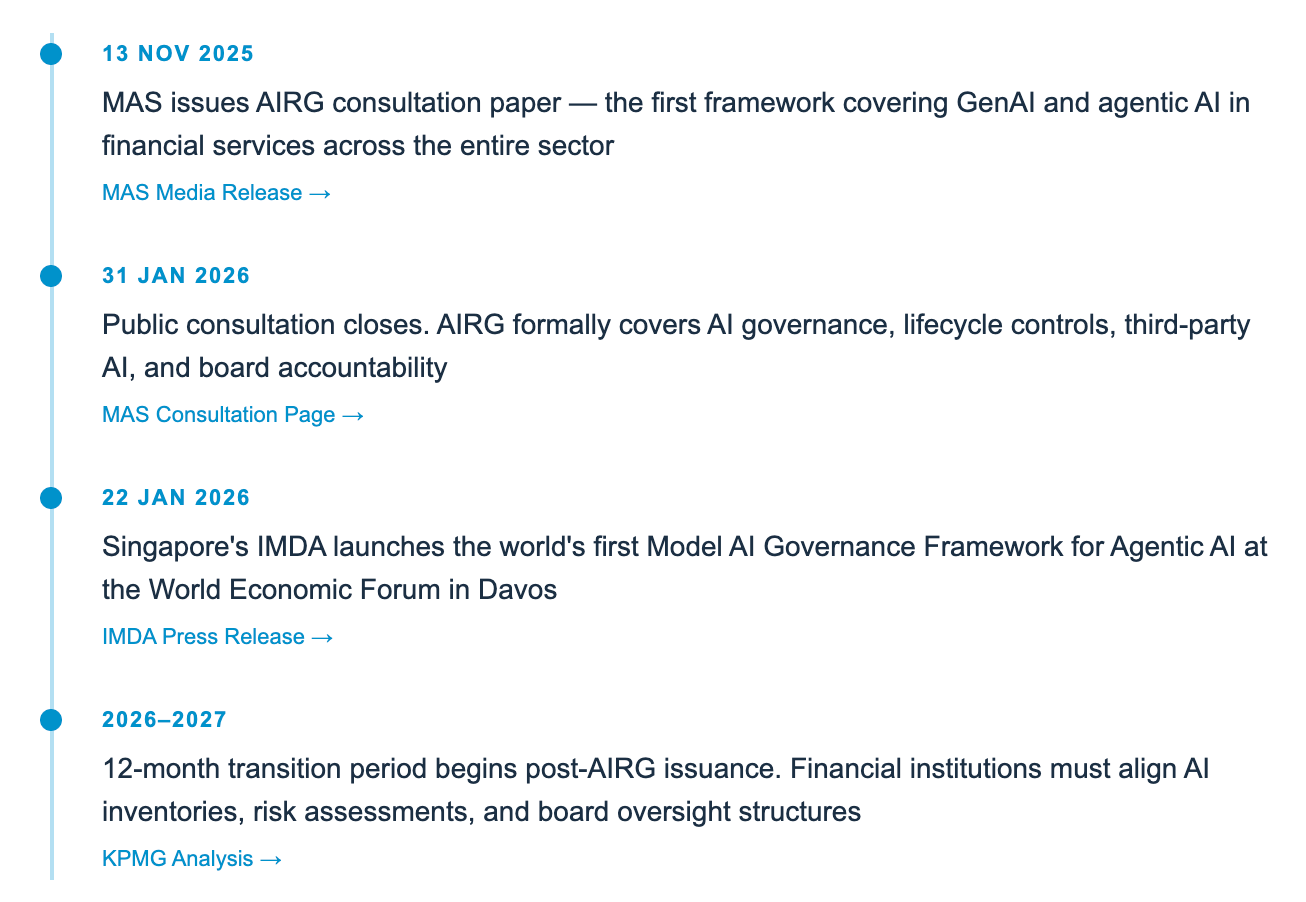
Three pillars underpin the AIRG: governance and board accountability for AI risk; a live AI inventory with risk materiality assessments across impact, complexity, and reliance; and lifecycle controls covering data quality, fairness, explainability, and human oversight.[4] For payment service providers, capital markets intermediaries, and fintechs operating under the PSA or SFA - which describes a large proportion of nVentures’ pipeline - this is not optional reading. It is the new operating environment.
Then, nine days later, IMDA raised the stakes further. On 22 January 2026, Singapore launched the world’s first governance framework specifically designed for agentic AI - systems capable of autonomous planning, reasoning, and action - at the World Economic Forum in Davos.[5] Two sweeping frameworks in the space of ten weeks. The signal from Singapore is unambiguous.
The Moat Nobody Talks About
Here is what most early-stage founders get wrong about compliance: they treat it as something you bolt on after product-market fit, when fundraising pressure or an enterprise sales process forces the issue. That thinking made sense in a softer regulatory environment. It is becoming increasingly expensive in this one.
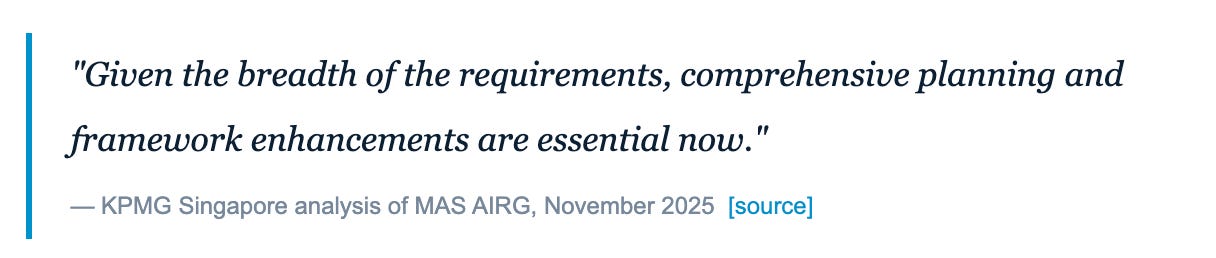
The B2B founders we back are selling into banks, insurers, and enterprise clients. When those clients begin requiring AI inventory documentation, explainability standards, and third-party risk controls from their vendors - and they will - the startups that have compliance baked into their architecture from day one will close deals faster, retain clients longer, and face lower switching risk from competitors.
The AIRG explicitly states that its requirements extend to third-party AI tools: any FI that uses, develops, procures, or deploys AI - including tools sourced externally - falls under the framework.[6] That clause is the one every B2B fintech founder selling into Singapore’s financial sector needs to have read. Your product is now part of your customer’s compliance obligation.
Compliance, built early, is not overhead. It is the moat.
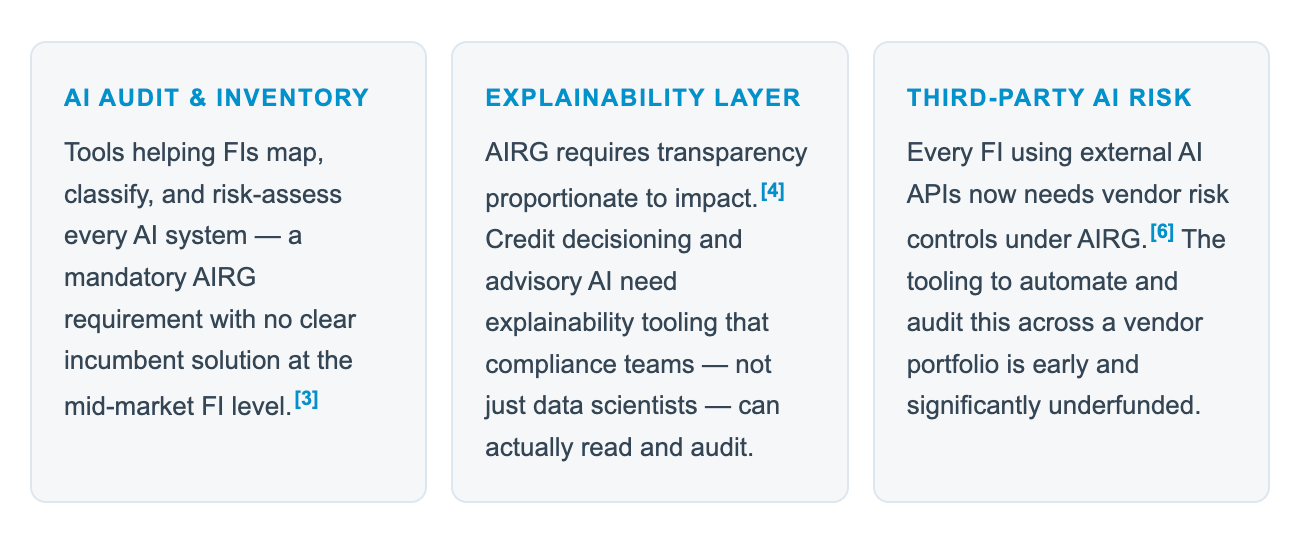
Three Verticals We Are Watching
Why This Matters for South Asia
Singapore’s AIRG will not stay in Singapore. Regulators in Sri Lanka, Bangladesh, and across Southeast Asia have consistently followed MAS’s lead on financial sector governance - typically within 18 to 24 months. Founders building compliance-native B2B fintech tools today are not just solving for one market. They are building frameworks that will be exportable across the region precisely when those markets need them.

At nVentures, we have always backed founders who build with durability in mind - not because it is easier, but because it compounds. A compliance-first architecture does not slow a product down. In a post-AIRG market, it is what gets you in the room.
If you are building in this space, we want to hear from you.
Sources
Monetary Authority of Singapore. Consultation Paper on Guidelines on Artificial Intelligence Risk Management (AIRG), P017-2025. 13 November 2025. mas.gov.sg →
MAS Consultation Page — AIRG. Closing date: 31 January 2026; 12-month transition period proposed post-issuance. mas.gov.sg →
KPMG Singapore. MAS Guidelines: Artificial Intelligence Risk Management (AIRG) 2025. 19 November 2025. kpmg.com →
Waystone Compliance. Consultation: MAS Guidelines on Artificial Intelligence Risk Management. 30 January 2026. waystone.com →
Infocomm Media Development Authority (IMDA). New Model AI Governance Framework for Agentic AI. Press release, 22 January 2026. imda.gov.sg →
Bird & Bird. Singapore Introduces New Model AI Governance Framework for Agentic AI. 23 January 2026. twobirds.com →